
What AI Cannot Replace in Product Development
AI is rapidly transforming product development, excelling at tasks like code generation, testing, and research summarization. However, don’t mistake acceleration for replacement. Building truly great products still hinges on uniquely human capabilities: sharp judgment, deep customer empathy, strategic prioritization, and commercial acumen. While AI provides powerful execution support, humans must retain control over vision, accountability, and critical trade-offs. The winning formula isn’t AI versus humans, but human leadership amplified by AI.
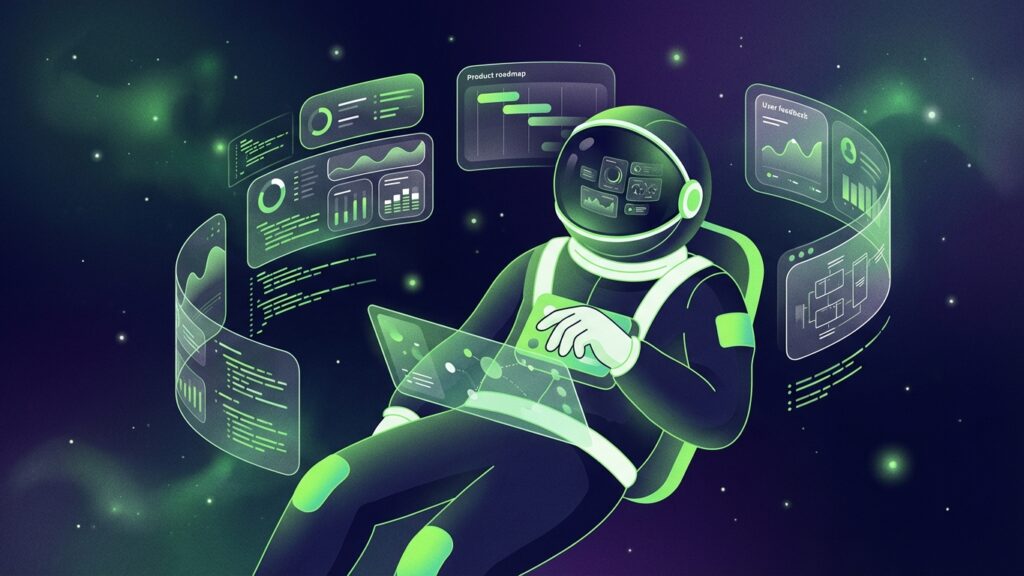
TL;DR: AI speeds up product dev. It handles the grunt work: code, docs, QA, automation. But it can’t replace human product judgment, empathy, strategy, commercial smarts, or accountability. The winners won’t be AI-only or human-only. They’ll be teams mastering the human-AI partnership, knowing exactly where to lead and where to leverage.
Context
AI is ripping through product development. It’s writing code, drafting docs, turbo-charging QA, summarizing research. It’s a friction-killer. But here’s the kicker: it’s not replacing product development. Not even close.
Building a killer product isn’t about just churning out features. It’s about making brutal judgement calls. Reading the room. Navigating trade-offs. Spotting the tiny, crucial signals. Deciding what ships now, what waits, and what gets killed before it even starts. That’s where human operators still run the show.
Structured Breakdown: Where Humans Still Lead
First, let’s be crystal clear: AI is a beast for execution support. When you use it right, it’s pure leverage. It helps with:
- Code scaffolds and repetitive tasks
- Drafting user stories and docs
- Spotting bugs, creating test cases
- Summarizing research, interviews
- Automating internal workflows, speeding handovers
This stuff is gold. It makes teams faster. It kills operational drag. It frees up hours. But faster output? That’s not the same as smarter product thinking. Here’s what AI absolutely cannot replace:
1. AI Doesn’t Have Product Judgement
This is the Everest. Product dev lives in the grey. You rarely get a clean answer. Every decision is a messy tangle of user need, tech limits, cost, speed, market position, and future scale. AI can spit out options. It can’t weigh them in context. It doesn’t feel the heat when a roadmap goes sideways. It doesn’t get the client politics. It won’t tell you if a feature is technically slick but commercially dead on arrival. Or if a founder is just over-engineering out of fear. That gut-level discernment? That’s human. A sharp product team knows when to simplify, when to push back, when to delay, when to cut. That’s not just smarts. That’s wisdom.
2. AI Lacks Customer Empathy
Products win when they fix real problems for real people. Sounds basic, right? Yet teams still ship based on vibes, internal debates, or chasing competitors. AI can summarize feedback. It can spot trends. It can crunch interview data. But it doesn’t *feel* the user’s frustration. It won’t catch the subtle hesitation on a sales call. It misses the emotional tells that scream: “This workflow sucks.” Great product isn’t about processing data; it’s about understanding messy human behavior. Users are illogical. They ask for X, need Y. They mask their true pain. They care about emotion as much as logic. Humans read between those lines. That edge is still critical.
3. AI Can’t Do Strategic Prioritization
Your roadmap isn’t a wish list. It’s a battle plan for time, money, and energy. Every feature is an opportunity cost. Every delay, a hit to momentum. Every shortcut, a risk. AI can sort your backlog. It can even suggest priorities based on patterns. But it won’t grasp investor pressure, market urgency, founder cash burn, or your team’s real capacity. Not like a human operator does. This is fatal in early-stage SaaS. Founders usually fail by building too much, too soon, in the wrong damn order. Prioritization isn’t about what’s possible. It’s about what moves the needle *now*. That still requires human leadership.
4. AI Lacks Commercial Acumen
A product isn’t art for art’s sake. It has to make money. Product dev must be glued to pricing, positioning, acquisition, retention, and monetization. A feature that looks brilliant on paper can sink your business. AI doesn’t think like a founder guarding runway. It won’t instinctively weigh if a request boosts activation, cuts churn, justifies a price hike, or shortens sales cycles. Humans do that. The best product decisions come from teams who get both the build *and* the balance sheet. They know it’s not about shipping the most, but shipping the *right* things that push the commercial model forward. AI handles the production. Humans protect the business.
5. AI Doesn’t Take Accountability
This is the silent killer. When something breaks, flops, misleads users, or burns cash, who’s on the hook? Not the model. AI doesn’t own a release. It doesn’t manage client blow-ups. It won’t take responsibility for bad architecture, security holes, or a missed launch. It won’t sit in that brutal post-mortem. Product development demands accountable humans: designers, devs, PMs, founders, leads. People who can say: “This is the path, this is the risk, this is what we do next.” Ownership is non-negotiable. In fact, the deeper AI embeds, the more crucial human oversight becomes.
6. AI Can’t Forge Original Product Vision
AI’s power is pattern recognition. That’s also its Achilles’ heel. It’s brilliant at plausible, derivative output. It sucks at category-defining vision. Real conviction. Breakthrough products stem from a sharp point of view. A founder spots a gap no one else sees. A team dives deep into a niche. A business makes a bold bet on future user behavior. That kind of vision doesn’t come from averaging past data. It’s pure human insight. AI can boost vision. It can’t originate it.
Insight: The Smart Play is Human-Led, AI-Assisted
Founders are making two classic blunders right now. First, ignoring AI and leaving massive efficiency gains on the table. Second, over-trusting AI to replace core product leadership. Both are expensive detours.
The winners? They’re getting tactical. They use AI ruthlessly for speed, automation, and grunt work. But they keep humans firmly in control of direction, quality, and commercial outcomes. It’s not AI *versus* humans. It’s AI *with* humans leading.
For serious SaaS, this is the only model that makes sense:
- Use AI for: Repetitive build support, docs, coding assistance, QA, workflow automation, research synthesis, fast iterations.
- Keep Humans Leading: Product strategy, customer understanding, UX judgment, prioritization, architecture decisions, commercial trade-offs, final quality control.
That’s where your real edge lives. Not in cutting people. In making the *right* people dramatically faster and more impactful.
Why This Matters
Right now, the air is thick with hype. “AI builds your app! AI replaces your dev team! AI designs your product! AI runs your workflows!” It’s seductive. It’s also setting you up for failure.
AI slashes time, cuts costs, and zaps repetitive tasks. True. But it doesn’t understand your market like a seasoned operator. It doesn’t shoulder responsibility for P&L. It doesn’t own the fallout from a bad product call. And let’s be real: the truly expensive mistakes in product dev aren’t about slow typing. They’re about building the wrong damn thing.
Especially for non-technical founders, this hype is a trap. Don’t believe prompts are enough. Don’t think product teams are optional. You can’t replace expertise, process, or solid delivery with a few tools. You’ll definitely move faster with AI. You’ll cut costs. But product development still demands experienced humans to forge vision into something usable, scalable, and commercially viable. Otherwise, you’re just accelerating your path to a hot mess.
Actionable Takeaway
AI is a game-changer. It’s redefining how we build. But the absolute core of product development remains fiercely human: Judgment. Empathy. Prioritization. Vision. Accountability. Commercial grit. These aren’t footnotes. They’re the foundation for anything people will actually use and pay for.
So, the question isn’t *if* AI belongs in product development. It absolutely does. The real question is: who’s still driving the ship? And the answer is crystal clear: humans, powered by AI.
FAQ/
AI is genuinely useful for generating code scaffolds, speeding up repetitive implementation, drafting documentation, identifying bugs, creating test cases, summarising research, automating workflows, and accelerating team handovers.
AI cannot replace product judgment, customer empathy, strategic prioritization, commercial understanding, accountability, and original product vision. These remain deeply human functions.
Human judgment is crucial because product development involves navigating complex grey areas, understanding context, political nuances, and knowing when a feature is commercially pointless. AI can generate options, but only experienced humans can truly judge their real-world implications.
The smarter model is ‘human-led, AI-assisted product development.’ This means using AI for repetitive build support and automation, while humans lead product strategy, customer understanding, UX judgment, prioritization, and commercial trade-offs.
Founders often either dismiss AI and miss efficiency gains, or over-trust it, assuming it can replace product leadership. Both approaches are costly; the winning strategy involves aggressive AI use for speed while keeping humans in control of direction and quality.
Ready to launch your SaaS in the following weeks?/
Book a strategy call and get a practical roadmap tailored to your current stage, team, and timeline.